
What is the method of Art Drip painting? Let’s figure it out.
Abstract Expressionism is a large-scale movement in 20th-century American painting that began in the late 1940s and became the dominant movement in Western art in the 1950s. The most prominent representatives of abstract expressionism were Jackson Pollock, Willem de Kooning, Franz Kline and Mark Rothko. Most of the Abstract Expressionists lived, worked and exhibited in New York.
Drip painting is a form of abstract art in which paint is dripped or poured onto a canvas. This style of battle painting was explored in the first half of the twentieth century by artists such as Francis Picabia, André Masson, and Max Ernst, who used drip painting in their “Amazed Planet” and “Young Man Intrigued by the Flight of a Non-Man”. Euclidean Fly (1942). Ernst used new ways of painting Lissajous figures by pumping a punctured bucket of paint across a horizontal canvas.
Drip painting is a painting technique that was developed by the surrealist and Dada artist Max Ernst as a wobble and was the first to show a tangled planet in a painting (1942). For this, a tin can was used, which the artist attached to a rope one to two meters long. At the bottom of this hole, there was a small hole from which the liquid paint filled in the jar could flow out. By moving the jar back and forth across the flat canvas, lines were created on the surface, reminiscent of mathematical graphs. Max Ernst, who invented several drawing and painting techniques that create random structures, only used dripping in some of the paintings of his later work.
The technique became known, in particular, through the American artist Jackson Pollock. Pollock mainly created large-format works for which the canvas was laid on the floor. The paint was applied with large brushes or dripped and spun straight from the paint pots. Another, more extreme form of drip painting is volumetric drawing, such as the work of Hermann Nitsch and Josef Trattner.
Drip painting, however, found particular expression in the work of mid-twentieth-century artists Janet Sobel and Jackson Pollock. Pollock found an IV to his liking; later, using this technique almost exclusively, he used such unconventional tools as sticks, hardened brushes, and even basting syringes to create large and energetic abstract works. Pollock used homemade or industrial paint to create his paintings—Pollock’s wife, Lee Krasner, described his palette as “usually a can or two of…enamel, thinned to the extent that he wanted it, standing on the floor, besides being rolled out on canvas”, and that Pollock used Duco or Davoe and Reynolds house paints. Home paint was less viscous than traditional tubes of oil paint, and Pollock thus created his large compositions horizontally to prevent his paint from running. His lines of gestures create a single overall picture that allows the eye to move from one canvas to another and back.
Sources for the drip technique include Navajo sand painting. Sand painting was also carried out on the ground. Another source is the “tinting” technique of Mexican muralists. Drop and splash marks made by mural artist David Alfaro Siqueiros allow him to compose his composition of many Mexican workers and heroes.
The pictorial material (which is usually not oily, but some type of opaque enamel or industrial varnish, such as those first used by Pollock himself around 1947) can be dripped onto the floor-smeared fabric from a perforated container, or spread by spraying, directly by hand or with brushes or any other tool.
Jackson Pollock. “Number 1 (Lavender Mist” (1950).
Canvas, oil, enamel, aluminum paint. 221 x 300 cm
National Gallery of Art, Washington DC, USA
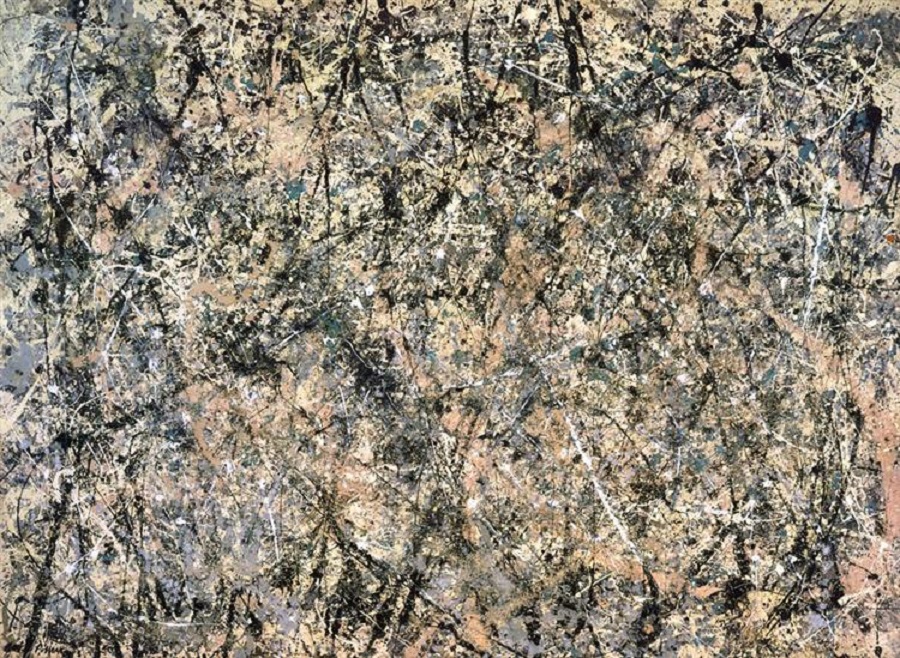
This typical “drip” picture was created by Pollock in his star year, 1950. By this time, the artist had brought to perfection the technique he had invented, but had not yet “worked out” it to the point of “automation” of the technique, threatening self-repetitions and ossification of the form.
Initially, the work was called “Number 1” (Pollock had a habit of naming paintings of the “drip painting” period by numbers). The romantic name “Lavender Mist” was suggested to Pollock by art critic Clement Greenberg, fascinated by the soft, pastel tones of this work. “Lavender mist” is distinguished by the tenderness of colors and their subtle combinations, bold color transitions, and exquisite patterns. The name proposed by Greenberg surprisingly accurately reflects the “smokyness” (with a predominance of lavender tones) of this work. Many critics tend to put “Lavender Mist” on a par with the later works of Claude Monet.
In the 1950s and 1960s, European informal movements often used dripping. Contemporary artists who have used drip painting include Linda Benglis, Norman Bloom, Dan Christensen, Ian Davenport, Ronald Davis, Rodney Graham, John Hoyland, Ronnie Landfield, Zane Lewis, Joan Mitchell, Roxy Payne, Larry Poons, Pat Steira, Andre Tomkins , and Zeus.
Since the early 2000s, some taggers such as Nebay and Erote in Paris or Cloun in Lyon have used drops to put their names on sidewalks.
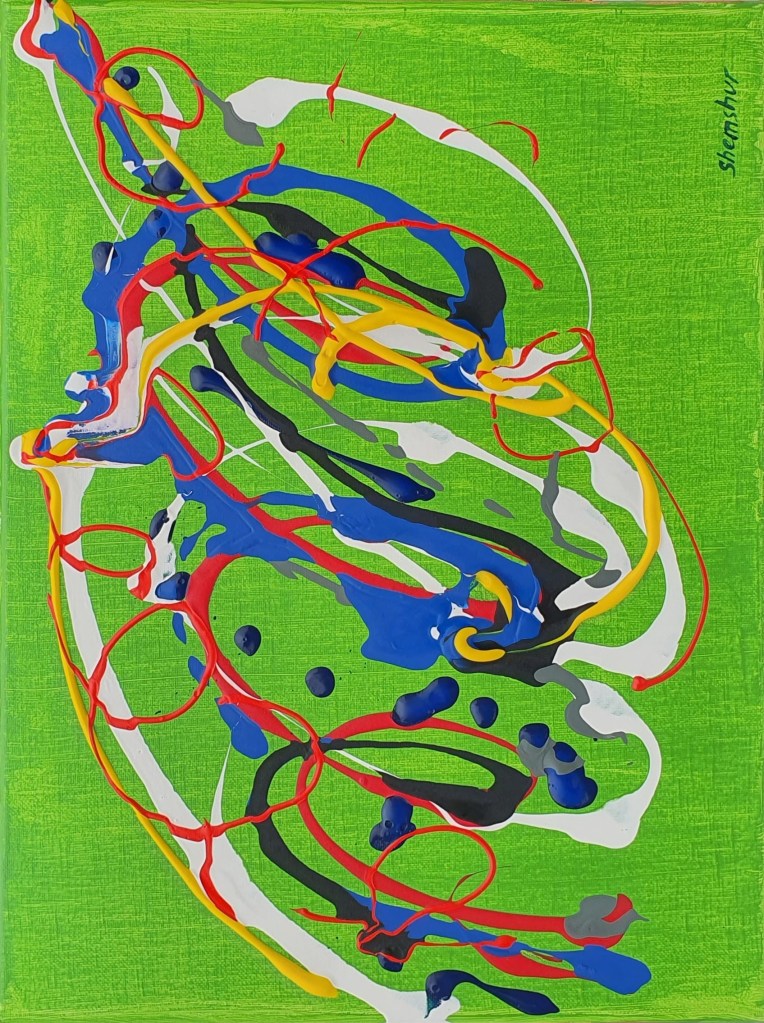
Shemshur_N_Lime_ice_cream_Acrylic_12x16in
I applied the method of drip technique, which really frees the artist from stiffness, from attachment to the object. Only the choice of color and their combination remains with the artist’s own aesthetic sense.
My bright painting below is made with this technique.
#artist #artcollector #art #artnyc #artgallery #saatchiart #artmajeur #artworks #oilpainting #acrylicpainting #artfair #abstract #Pollock
 Art is life
Leave a comment