An art series is a cohesive group of works that uses the same technique, theme, or palette across multiple pieces. Creating your own series can be a great way to improve your skills and explore a particular theme or style in more detail. Having a series or two under your name is also helpful when showing your work in galleries, at fairs, or online, letting viewers know what you can do. It’s also a great way to increase your sales by having multiple versions available to interested buyers.
Stage 1: Finding a theme that will sustain your interest.
Creating an art series can take a substantial chunk of time, so you’ll want to choose a theme that will sustain your interest for an extended period whilst avoiding being too general.
Do
- Choose something that is specific or personal to you, but open to variation.
- Select a subject that will hold your interest for an extended period of time.
Don’t
- Base your art series on something too general or broad.
- Imitate other artists—find a way to distinguish your take on the same theme.
For example,
if you love ballet, for instance, how can you make your work distinct from other artists who have painted ballerinas, such as Edgar Degas? Maybe your dancers could occupy unusual locations: fairgrounds, factories or farmlands. Or perhaps you’ll paint them all in neon. However you approach it, make sure that it resonates with you personally, having an emotional connection with your subject is the best way to ensure you remain inspired. Your audience will be able to sense your interest, making the work all the more appealing and unique.
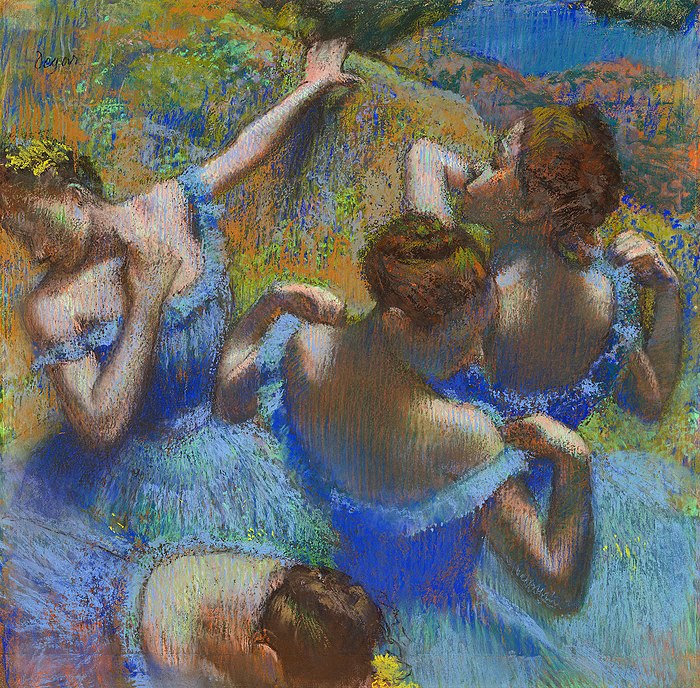
Edgar Degas
Blue Dancers. 1897
Danseuses bleues
Paper, pastel. 65 × 65 cm
A.S. Pushkin Museum of Arts, Moscow
The French critic Edmond de Goncourt wrote the following about the artist’s love for the ballet theme: “He mixes the aesthetics of dance with the aesthetics of painting”
Stage 2: Do your research
Research is especially important when creating an art series. Producing multiple artworks on the same theme means you must consolidate your understanding of the subject to approach it from multiple angles. Brainstorming your way around a topic is a great way to make unexpected associations, and identify any gaps in your knowledge. Once you have a basic outline of themes and sub-themes, start collecting research material. Try visiting the local library or searching online to find out how other artists have approached similar subjects, or experimented with certain colour palettes or mediums. Remember, you can, and should, conduct your own primary research alongside this: take photographs, make sketches, try out different compositional arrangements using collage, interview members of your community. Whatever will help you to build up a well of relevant reference material.
Think about what you want your art series to say as you evaluate this material, does a narrative emerge? Will your series be chronological or non-linear? What colours stand out, and what historical or cultural implications do they have? These are all important questions to consider at the research stage of your series.
Do
• Brainstorm your area of interest.
• Take your time, visit the library and fill in the gaps in your knowledge.
• Conduct your own ‘primary source’ research: take photos, conduct interviews, sketch from life, etc.
• Build up a varied and high-quality stock of reference material.
• Consider chronology and narrative.
Don’t
• Rely too heavily on the internet. Your first-hand observations are often the most unique and interesting!
• Rush! Research takes time, give yourself an adequate research period of 1–2 weeks (or longer) to collect high-quality reference material
Stage 3: Set rules and parameters
Creating a series of artworks can be a delicate balancing act. A good series should allow each artwork to stand on its own, whilst simultaneously relating to the body of work as a whole. But how to make multiple works fit together without them becoming either too repetitive or disparate?
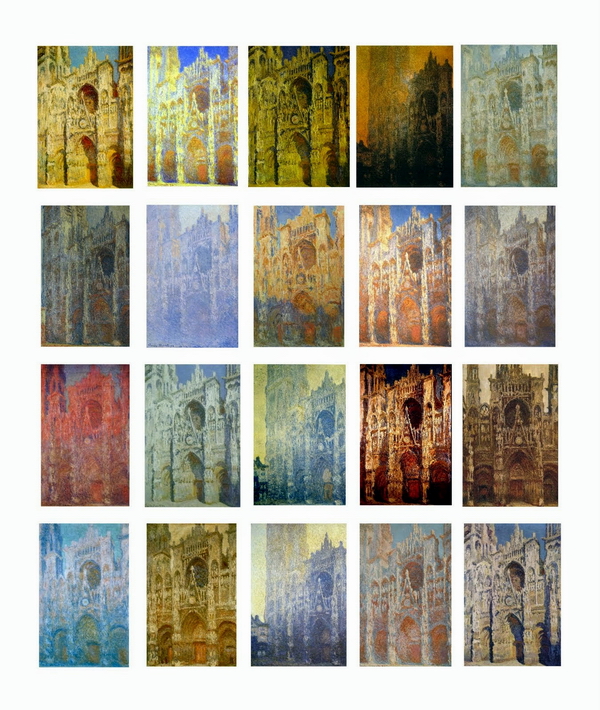
Creating a set of clear, cohesive rules will help to strike the right balance between consistency and difference. Take Monet, for example, who between 1890 and 1891 made over thirty paintings of the haystacks near his house in Giverny. In what was effectively an intricate study of light, Monet documented the haystacks at different times of the day through different seasons. A fairly simple idea that wielded beautiful results for Monet, who repeated this methodology in 1894 when he rented a room opposite Rouen Cathedral to paint its western façade. Keeping multiple canvases on the go, he moved from one to the next as the light shifted. When creating your own parameters, you’ll want to clarify your aim, followed by 2–4 simple rules. Let’s use Monet’s Rouen series as an example:
Aim
To capture an atmosphere through light
Rules
- Fixed views of subject: work from designated positions
- Paint at designated times, consistently through seasons (e.g. 08:00 – 10:00, 12:00-14:00, 16:00-18:00, 20:00-22:00)
- Style: Impressionistic, using thick impasto layers of paint
- Palette: Unlimited
Sticking to these simple rules, Monet created 30 unique individual pieces that only increase in beauty when seen as a whole. His parameters allowed him to capture the fleetingness of a single moment through his expressive portrayal of evanescent light upon a fixed and stony subject.
Do
Clarify the aim of your series.
Make your rules simple and easy to follow.
Be consistent with your parameters.
Give yourself some element of freedom. For Monet, this was colour.
Don’t
Repeat the same scene with little or no variation.
Set too many restrictions, or over-complicate your parameters.
Working on an art series can be both a creative and organized process. There are several aspects to consider to ensure a successful outcome. Here are the dos and don’ts of creating an art series:
Let’s Sum Up
Do’s:
– Clearly define the concept:
Identify a central theme or idea in advance that will unite all the works in the series. This will help create a cohesive and complete piece.
– Research and plan:
Research your chosen theme, study the work of other artists, and determine how you want to express your idea.
– Make sketches and rough sketches:
Make preliminary sketches to visualize your ideas and determine how they will be implemented in each piece in the series.
– Experiment with materials and techniques:
Try different materials and techniques to find the ones that best express your concept.
– Set a work schedule:
Develop a work plan and stick to it to use your time efficiently and avoid protracting the process.
– Ask for Feedback:
Share your work with colleagues, teachers, or friends and accept constructive criticism that can help improve your work.
– Prepare your work for exhibition:
Think about how you will present the series, including the design and placement of the works in space.
Don’ts:
Don’t start work without preparation and planning, this can lead to wasted time and effort.
– Ignore details:
– Uncertainty in concept:
Avoid vagueness in the main idea. Without a clear concept, the series may look disjointed.
– Ignore the planning process:
Lack of attention to detail can weaken the overall impression of the series.
– Isolate yourself from external criticism:
Don’t ignore the opportunity to receive feedback. An outside perspective can open up new perspectives.
– Ignore variety:
Repeating the same approach across all works can make the series boring. Find a balance between variety and unity.
– Hasty decisions:
Don’t rush to complete your work, take the time to think about and refine each work.
– Forgetting the target audience:
Don’t lose sight of who will see your work and how it will be perceived by the viewers.
Following these guidelines will help you create an art series that is deep, complete, and memorable.
Did you like the article? Support with like and subscribe! Thank you.
Until next time,
Artist Nata Shemshur
https://www.natashemshur.com
https://www.instagram.com/artnatashemshur/
https://linktr.ee/ArtNataShemshur
⭐⭐⭐⭐⭐Рейтинг: 5 из 5.
Оставьте комментарий
Опубликовать комментарий…

комментарий
#artist #art #artcollector #artpainting #artgallery #artist #artfair
Art Nata Shemshur
 Art is life
Leave a comment