
You have done a piece you’re proud of. It is beautiful, expressive, and completely “you.” However, when you put this in front of you and are wondering, how do I price it? Pricing their work is the hardest part of it for many artists. You don’t want to overcharge and scare away buyers, but undercharging feels like you don’t even value your effort. Learning how to price your art is a blend of strategy and self-worth. This helps you make smart and confident pricing decisions.
1. Start With Your Costs
Figure out the first thing: what it costs to create the piece. That could include materials such as canvas, paint, brushes, digital tools, and electricity. Next, include the time you’ve spent working on it. Then, ask yourself what your time is worth per hour. If you spent 15 hours and valued your time at $20/hour, that’s $300 already. If you add in your material costs, you have a good initial price. That is the absolute minimum you should charge.
2. Research the Art Market
Consider how much other artists are charging for the same work. Search for artists in your style, medium, and skill level. Is it by size, by complexity, or by the amount of money garnered? Study the ranges and take notes. This allows you to have an idea of your place in the current market. No one is copying anyone; you are learning what the market values in art like yours. Doing this will give you some extra confidence when pricing your art at the appropriate price.
3. Size and Medium Affect Price
Generally, bigger pieces cost more than smaller ones not only because of their size, but also because they generally require more time and materials. A sketch of 6×6 is so easy, while painting an oil painting of 36×48 is harder . However, size isn’t everything; some small, detailed pieces can be just as time-consuming. Think about how collectors perceive your chosen medium and price accordingly.
4. Your Experience Counts
Your experience level definitely affects how people see your resume. Also, your prices should reflect that experience. For example, if you’ve been in galleries or sold work, price accordingly. Even having a growing following can matter. Because of that, some buyers see experienced artists as more valuable.
5. Create a Price Range
Different price points allow more people to afford your work. At lower prices, you can sell small sketches, prints, or digital downloads. You can keep your originals or large pieces at a premium rate. In this way, you won’t be restricting yourself to a single type of buyer. A smart price range is a smart sales increase for your art value as well as your chances of closing a sale.
6. Don’t Let Emotions Decide
Usually, you can get attached so much to a piece of work and you want to price it higher due to that emotional connection. Remember that your buyer doesn’t always share this feeling. Be objective. Do not price based on how much you love the piece: price it based on the amount of time, materials, and effort involved. This will help you maintain your professionalism.
7. Be Consistent With Pricing
Consistency builds trust. Buyers get confused or uncertain about whether an artwork is worth its price when a similar artwork has a different price. The best price is the one that makes sense; some artists price by square inch, some by hours, and so on. Pick a solution that suits you and use it in your work. This steady structure provides you with the information that your prices are fair, not random. Not only does this help you set your custom pricing in order, but it also makes buyers feel more comfortable.
8. Update Prices Over Time
As you mature, your prices should mature. If you are regularly selling, becoming better at it, or collecting followers, then it’s time to increase your rates. Don’t be afraid to review your prices every 6–12 months. Pricing is part of your artistic journey. As your art value grows, so should your income. Keeping your prices up to date is a reflection of your personal growth and the rising demand for your work.
9. Tell the Story Behind Your Work
Your art is the story, not just the image. People connect more when you share your process or the thing that inspired it. With this emotional aspect, you can justify higher prices. The story, the way the mood, the experience, that’s what gives art value and not what’s on the canvas. With each piece you sell, share a little piece of your heart.

10. Believe in Your Work
This one is probably the most important. To know how to price your art, first believe it has worth. You’ll doubt yourself, and others will doubt you as well. Take pride in the hours, talent, and heart you invest into each piece. Nobody can create the same thing like that. You’re offering something different. The harder you believe in your work, the easier it is to stand behind your prices. Confidence also helps others realize the worth of what you do.
FAQs
1. How do I know if I’m underpricing my art?
If your art sells too quickly or you feel resentful after a sale, you might be underpricing it. Track your time, material costs, and compare with similar artists. If your pricing doesn’t reflect your effort or the market, it’s time to raise it.
2. Should I price my art by size or by time spent?
Both methods work; it depends on your style and process. Pricing by size is common and easy for buyers to understand. But if your art is very detailed or time-consuming, a time-based pricing model may better reflect its art value.
Conclusion
Pricing your art is a learning process. It’s not going to be perfect every time, and that’s okay. First of all, find out your costs, research what other people are doing, and include your time and talent. But, be fair, be consistent, and update your prices as you grow. Above all, trust in yourself and do not let fear lead you. You have value, and your art has value. Now price your next piece with confidence.
Price Calculator: Painting, Works on Paper, Photography, Prints & Sculpture
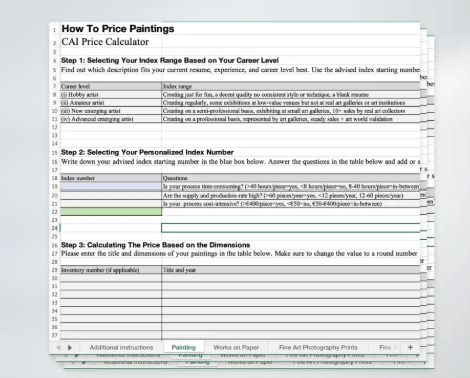
Only with the correct prices can an artist achieve good sales. If you get the prices wrong, no matter your efforts, sales are unlikely to happen. Pricing your art seems incredibly difficult due to the tremendous amount of conflicting information and advice available online. However, it shouldn’t be that difficult. In fact, it is actually very easy.
Therefore, we have developed the CAI Price Calculator: an easy-to-use Excel spreadsheet to calculate your price following the market standards for paintings, works on paper, fine art photography prints, art prints as reproductions, and sculptures. This tool was developed on the occasion of our extensive article on How To Price Your Art. You can consult the article for more context and information here.
→ Pricing tool to calculate prices of artworks in line with the market standards & expectations
→ Applicable to paintings, works on paper, fine art photography prints, art prints & sculptures
→ Avoid setting your prices too low or too high
→ Raise your prices in bulk by changing just a single index number
→ Includes important information what elements effect the value of your artistic discipline
Did you like the article? Support with like and subscribe! Thank you.
Until next time,
Artist Nata Shemshur
https://www.natashemshur.com
https://www.instagram.com/artnatashemshur/
https://linktr.ee/ArtNataShemshur
⭐⭐⭐⭐⭐Рейтинг: 5 из 5.
Оставьте комментарий
Опубликовать комментарий…

комментарий
#artist #art #artcollector #artpainting #artgallery #artist #artfair #pricemyart
Art Nata Shemshur
 Art is life
Leave a comment